 collage
To get all the important details you need on Federal Student Loans – Pros and Cons, and lots more All you have to do is to please keep on reading this post from college learners. Always ensure you come back for all the latest information that you need with zero stress.
There are two main types of student loans: federal student loans — issued by the U.S. Department of Education — and private student loans. Both differ in interest rates, eligibility requirements, loan modification options and forgiveness programs.
Although federal loans offer more flexible repayment terms, a private student loan can help cover your school’s total cost of attendance if you’ve exhausted all other options.
Take advantage of our best student loan guide and find the best lenders to help meet your higher education goals.Ad A Student Loan is a smart way of covering your college costs.There’s no shortage of expenses in college life. Get the help you need with a Student Loan. Click on your state to find out more today.
6 Best Student Loans of June 2022
Published: Jun 02, 202232 min readSHAREAd




Federal Student Loans – Pros and Cons
Federal student loans are backed by the U.S. Department of Education and offer exclusive benefits and repayment options that are not available with private student loans.
There are four main types of federal student loan programs available to undergraduate and graduate students as well as parents seeking financial aid to fund their children’s education.
Direct Subsidized Loan
- Only available to undergraduate students who demonstrate financial need
- Loan amount depends on the school’s cost of attendance
- U.S. Department of Education pays the interest on the loan while you’re in school at least half-time, during the grace period after you leave school and during deferment
Direct Unsubsidized Loan
- Available to undergraduate, graduate and professional students
- No need to demonstrate financial need
- Loan amount depends on the school’s cost of attendance and other financial aid received
- Students are responsible for paying interest at all periods
Direct PLUS Loans
- Available to graduate and professional students as well as parents
- Requires credit check, and borrowers with adverse credit history must meet additional requirements
- Loan amount depends on the school’s cost of attendance minus other financial aid received
Direct Consolidation Loans
- Allow borrowers to combine multiple federal education loans into one loan
- Has a fixed interest rate that an average of the interest rates on the loans being consolidated
- Monthly payments may be lower, but borrowers may end up paying more interest over the life of the loan

Best Private Student Loans Reviews
Our PartnerAPPLY TODAYBest Overall: College Ave
Why we chose it: We chose College Ave as best overall due to its wide array of repayment options, a rarity in private lenders, and because of its few fees and no prepayment penalties.PROS
- Approval decisions in as little as three minutes
- More repayment options than other student loan lenders
- Free prequalification without a hard credit pull
- Allows cosigner release
CONS
- International students can only apply with a qualified cosigner
- U.S. students must make over half of the scheduled payments on time before they can apply for the cosigner release
RATES
Undergrad rates — Variable: 1.19%–11.98% with autopay discount
Undergrad rates — Fixed: 3.49%–12.99% with autopay discount
Graduate rates — Variable: 1.99%–10.97% with autopay discount
Graduate rates — Fixed: 3.99%–11.98% with autopay discount
College Ave Student Loans offers student borrowers and parents fixed and variable interest rate loans as well as student loan refinancing options. You don’t need to be enrolled half-time in a degree-granting institution to be eligible for a College Ave private student loan. However, this lender does require all applicants to have a valid U.S. social security number, including international students, who are also required to apply with a qualified cosigner.
If enrolled in a qualifying institution, students can apply for $1,000 or up to the school’s total cost of attendance.
Undergraduate students who need to borrow more money may apply for College Ave’s Multi-Year Peace of Mind loan program. However, all additional loans must be submitted with a cosigner to be approved.
Repayment Options and Fees
While in school, College Ave offers borrowers multiple repayment options, including interest-only payments, full principal and interest payments, and flat $25 monthly payments.
The online lender does not charge late fees, application or origination fees. They also don’t penalize borrowers for paying off their loans early. Borrowers can enroll in automatic payments and get a discount of up to 0.25%.
Loans offered by College Ave
- Undergraduate
- Career
- MBA
- Medical school
- Graduate Health Professions
- Dental school
- Law school
- Parent PLUS
- Student loan refinance
Our PartnerAPPLY TODAYBest for Graduate Students and Non-degree Granting School: Sallie Mae
Why we chose it: We chose Sallie Mae as the best for graduate students because of its Graduated Repayment Program, which allows borrowers to make interest-only payments for a year after graduation.PROS
- Fixed APR rates starting at 3.75% for undergraduate students
- Four months of Chegg tutoring service for undergraduate loans
- Free access to your FICO score, updated quarterly
- No origination fees
- Cosigner release option
CONS
- No information available about credit score requirements
- Charges late payment fee
RATES
Undergrad rates — Variable: 1.87%–11.97% with autopay discount
Undergrad rates — Fixed: 3.75%–12.85% with autopay discount
Graduate rates — Variable: 2.62%–12.11% with autopay discount
Graduate rates — Fixed: 4.75%–12.11% with autopay discount
Sallie Mae Loans are available for graduate, undergraduate and vocational students attending non-degree-granting schools. Sallie Mae is also one of the few lenders with student loan options for part-time students.
If you attend a non-degree granting school, Sallie Mae’s Career Training student loan offers competitive fixed- and variable-rate loans without origination fees or prepayment penalties. Fixed-rate loans range from 3.75% to 13.29% APR, while variable-rate loans start at 1.87% and go up to 12.48%.
Additionally, Sallie Mae offers a “multi-year advantage” for returning students, which allows recipients to continue borrowing year after year if they meet credit and income qualifications. Note that chances for approval are significantly higher with a cosigner.
One drawback of doing business with Sallie Mae is that you won’t get a personalized rate until you apply. And while Sallie Mae doesn’t disclose credit requirements for all of their loans, the average minimum credit score for undergraduate student loan borrowers is 748.
Repayment options and fees
As a Sallie Mae borrower, you can choose from interest-only, fixed-monthly repayment options or and defer payments while in school. You can also get a 0.25% interest rate discount for enrolling in autopay and the option to enroll in the Graduated Repayment Period for any loan.
This program allows you to make interest-only payments for a year after graduation while you’re transitioning from school to your new career. All of Sallie Mae’s loans are 100% coverage, meaning that they help finance all of your education-certified expenses including travel, tuition, housing, books, fees, and your laptop.

Loans offered by Sallie Mae:
- Undergraduate
- Career training
- Graduate
- MBA
- Medical school residency
- Dental school residency
- Health professions graduate
- Law school
- Bar study
Why we chose it: We chose Credible as best for parents because it allows borrowers to compare parent student loans from multiple lenders, and prequalify without a hard credit check.PROS
- Compare multiple loan offers with a single loan application
- Get prequalified online without a hard inquiry
- No origination fee, service fees or prepayment penalties
- Finance any type of degree
- Apply with or without a cosigner
CONS
- Most Credible partner lenders require a minimum credit score of 680
- Specific programs, APR rates, terms and conditions may vary depending on the lender
- Does not service its own loans
RATES
Undergrad rates — Variable: 1.13%–11.98%
Undergrad rates — Fixed: 3.20%–14.52%
Graduate rates: Vary by lender
Credible is a free online marketplace where you can compare rates and terms from multiple private student loan providers at once. The platform features a pre-qualification tool that gives potential borrowers personalized rates.
When you request personalized rates from Credible, the platform will conduct a soft credit inquiry to provide you with a list of student loan offers within your budget. This inquiry has no effect on your credit score.
The platform partners with private student loan lenders like Ascent, Citizens Bank, Discover, College Ave, EDvestinU, INvestEd, MEFA and Sallie Mae.
Most Credible partner lenders ask for a minimum credit score of 680 to qualify for a loan. Additionally, student loan rates may start at 3.20% fixed APR and 1.13% variable APR for those with excellent credit.
As this is a marketplace, specific programs, APR rates, terms and conditions depend on the lender you choose.
Repayment options and fees
The platform partners with private student loan lenders like Ascent, Citizens Bank, Discover, College Ave, EDvestinU, INvestEd, MEFA and Sallie Mae.
One benefit of comparing lenders with Credible is that it doesn’t partner with lenders that charge origination fees, or prepayment penalties on their student loans.
Loans offered by Credible partners
- Undergraduate
- Graduate
- Parent student loans
Why we chose it: We chose SoFi as best for no fees and discounts because of its lack of fees and exclusive rate discounts (and other partner benefits).PROS
- SoFi app reward points can be used to pay eligible student loans
- Unemployment Protection Plan allows you to suspend loan payments for up to 12 months
- No cosigner required to apply
- Personalized career advice through SoFi’s exclusive Career Services
CONS
- A minimum credit score of 680 for eligibility
- Interest will accrue during each three-month forbearance period
- Minimum loan amount is $1,000 for undergrad and graduate student loans
RATES
Undergrad rates — Variable: 1.64%–11.67% APR with autopay discount
Undergrad rates — Fixed: 3.22%–10.91% APR with autopay discount
Graduate rates — Variable: 2.34%–11.57% APR with autopay discount
Graduate rates — Fixed: 2.34%–11.57% APR with autopay discount
SoFi considers professional history, cash flow and history of financial responsibility when you apply for its student loans. To be eligible, you must also be enrolled at least half-time in an accredited four-year degree-granting institution.
As a SoFi member, you’ll gain partner-offered benefits including access to Best of Evernote for six months and a rewards points program. To earn points, SoFi members must download the app and use it to manage banking accounts, credit cards, loan payments, or investments. For every app transaction, users earn redeemable points that can be applied toward student loan payments. Some of these benefits are not available to residents of Ohio.
Repayment options and fees
SoFi offers flexible repayment options for all student loan borrowers, including unemployment protection (forbearance) for those who lose their job through no fault of their own and whose loans are in good standing. Interest will accrue during each three-month forbearance period, but you have the option of making interest-only payments during that time.
Additional repayment options include deferred payments for six months after graduation, interest-only payment during school, fixed $25 monthly payments during school and full monthly payments post-graduation.
With SoFi, there are no application or origination fees tied to your private student loan. There are also no prepayment penalties. Additionally, SoFi borrowers can get exclusive rate discounts of up to 0.25% if they subscribe to automatic monthly payments.
Loans offered by SoFi
- Undergraduate
- Graduate
- MBA
- Law school
- Parent PLUS
Our PartnerAPPLY TODAYBest for Borrowers Without a Cosigner: Ascent
Why we chose it: We chose Ascent as the best for borrowers without a cosigner due to its specialized non-cosigned loan for both DACA and international students.PROS
- No application, origination, disbursement, or early repayment fees
- 1% cash back graduation reward
- Receive up to $525 for each friend you refer through the Refer a Friend Program
- Non-Cosigned Outcomes-Based Loan is available for undergraduate juniors or seniors who do not have a cosigner
- Start payments up to 9 months after graduation
- Pre-qualify online without affecting your credit score
CONS
- Higher interest rates compared to most private lenders
- International students can’t apply for cosigner release
- Students must meet minimum credit requirements
RATES
Undergrad rates — Variable: 1.64% – 9.23%
Undergrad rates — Fixed: 4.78% – 12.76%
Graduate rates —Variable: 1.66% – 10.98%
Graduate rates — Fixed:4.90% – 14.52%
Ascent is one of the few private lenders that offer a loan program that bases eligibility on factors like academic performance (GPA), school, program and major. It’s also one of the few lenders that specifically advertise no-cosigner student loans options for DACA students and international students, as well as personal loans for financial aid officers.
Ascent’s Non-Cosigned Outcomes-Based Loan is available for undergraduate juniors or seniors who don’t have a cosigner and don’t meet minimum credit requirements. This loan targets aspiring graduates that are about to enter the workforce and have a minimum GPA of 2.9.
If you have school loans without a cosigner as a junior or senior, you can only repay them after you graduate, with loan terms lasting between 10 and 15 years. To qualify for loans that do require a cosigner, you have to be enrolled in school at least half-time.
Repayment options and fees
Ascent borrowers have flexible repayment options, including deferred payments up to nine months after leaving school, $25 monthly payment while in school, interest-only repayment while in school and forbearance and deferment options from 1 to 36 months (depending on the type of loan).
With Ascent, there are no origination, application, disbursement or prepayment penalties tied to undergraduate or graduate private student loans.
Ascent also allows customers to apply for cosigner release after 24 consecutive on-time payments. Additional perks include 1% cashback and a 0.25% discount for automatic debit payments.
Loans offered by Ascent
- Cosigned Credit-Based loan
- Non-Cosigned Credit-Based loan
- Non-Cosigned-Outcomes-based loan (for juniors and seniors)
- MBA
- Law
- Dental
- Medical
- PhD
Why we chose it: We chose LendKey as the best marketplace because despite partnering with a large network of lenders, it services loans itself, with its own customer service.PROS
- Partners with credit unions and community banks
- Services loans itself and offers in-house customer service
- Offers a cosigner release option after 12-48 on-time payments
- $200 referral bonus for each person you recommend who signs up
- Less 23 student loan-related complaints with the Consumer Financial Protection Bureau (CFPB)
CONS
- Those with credit scores below 660 or incomes lower than $24,000 must apply with a cosigner
RATES
Undergrad rates — Variable: 1.66%–7.66% with autopay
Undergrad rates — Fixed: 3.99%–8.49% with autopay
Graduate Rates: Vary by lender
LendKey is a loan marketplace that partners with over 13,000 community banks and credit unions. If you prefer doing business with regional lenders and co-ops, LendKey could be an option for you.
Unlike other marketplaces, LendKey services loans and offers in-house customer service. That means partner lenders issue loans through LendKey’s automated digital platform and the company takes care of interactions with customers, which translates into lower rate offers for qualified borrowers.
Loans obtained through LendKey can be used to finance education-related expenses certified by your institution. This includes room and board, tuition, fees, transportation, laptop and textbooks.
Since LendKey works with community banks and credit unions, rates and terms may vary significantly. Some financial institutions may ask you to meet additional loan eligibility requirements in order to qualify for their student loan products.
Applications are credit-based, so you must be prepared to have a cosigner if you don’t meet eligibility criteria. Supporting documentation for cosigners includes proof of income, permanent address or social security identification.
To be eligible for a private student loan through LendKey, you must be a U.S. citizen or permanent resident, be of legal age in your state of residence and be enrolled at least half-time in a degree-granting program or approved school.
Repayment options and fees
Repayment options for LendKey’s student loans include fixed or interest-only repayments while in school, and up to six months of forbearance.
As a marketplace, LendKey offers private student loans and student loan refinancing with no application or origination fees.
Loans offered by LendKey
- Undergraduate
- Graduate
- Student loan refinance
AdGet ahead of the 2022-2023 school year and apply for your Student Loan today.Lenders can put a world of possibility within your reach. Get the financial aid you need to cover tuition and materials. Click below to find out how.
Student Loans Guide
Because comparing student loans can be stressful for both students and their families, we’ve outlined what you need to know to navigate the process.
How do student loans work?
Student loans are issued by the federal government or private lenders to help pay for undergraduate or graduate studies. The loan goes towards tuition, books, student housing and other education-related expenses.
Once a student loan application is approved, the funds are sent directly to the school to cover tuition, fees and on-campus student housing. The remaining balance is disbursed to the student.
Private loans accrue interest from the start of the loan, while federal loans have more flexible terms. Depending on the loan type, repayment may begin after you graduate and find employment or while you’re still in school.
Types of student loans
Since private loans don’t offer the same protections that federal loans do, the general advice is to seek private student loans after you’ve exhausted every federal option.
Federal student loans
Federal student loans are the first choice for many due to their low rates, flexible repayment options and federal protections.
The U.S. Department of Education offers the following loan options:
- Need-based: Direct Subsidized Loan
- Non-need-based: Direct Unsubsidized Loan and Direct Plus Loan
To apply for federal loans and additional financial aid, students must submit the Free Application for Federal Student Aid (FAFSA) once every school year.
Your school will calculate how much you’re eligible to borrow based on the cost of attendance and your family’s financial information.
Final loan awards can’t exceed loan limits set by the federal government, but the school may award you less than what you request.
The federal government limits how much a student can borrow annually and over their entire college career across different categories:
- Academic year
- Loan type
- Undergraduate and graduate studies
- Independent or dependent student
Benefits of federal loans include:
- Lower interest rates
- Subsidized interest payments
- Forbearance
- 6-month grace period after graduation
- Income-driven repayment plans.
- Possibility of loan forgiveness
Private student loans
Private student loans are similar to personal loans, as they are issued by private banks or credit unions.
Private student loan lenders look at students’ credit scores and credit reports to determine interest rates and loan approval. Since most students don’t have enough credit history, lenders often require a qualifying cosigner.
Private loans don’t feature the same benefits as federal student loans, but they can help pay your school’s total cost of attendance if you’re no longer eligible for federal aid. Most schools will have a list of recommended lenders they partner with.
You will receive the remaining loan amount directly from the school after tuition, fees, and student housing are covered.
Most private lenders start loan repayment while you’re still in school, but some do extend deferment or grace periods, although interest will continue to accrue.
Student loan terms
Federal student loan terms are set by law, while the lender determines private student loan repayment plans. When shopping for private student loans, borrowers should compare repayment options to see which lender allows more flexibility.
Federal student loan terms
For federal student loans, the government offers multiple repayment plans that can be grouped as follows:
| Repayment plan | Monthly payment | Repayment period | How it works | Eligible loans |
| Standard repayment plan | Fixed monthly payments of at least $50 | Up to 10 years (between 10 and 30 for consolidation loans) | Payments are spread out in equal installments over the loan term | • Direct Subsidized/Unsubsidized • Direct PLUS • Direct Consolidation • Subsidized/Unsubsidized Stafford • FFEL PLUS/FFEL Consolidation |
| Graduated repayment plan | Payments increase every two years | Up to 10 years (between 10 anf 30 for consolidation loans) | Monthly payments gradually increase over time | Same as standard repayment |
| Extended repayment plan | A fixed or graduated amount | Up to 25 years | Allows you to make a lower payment for a longer period | Same as standard repayment |
| Income-based repayment | As low as 10% of your discretionary income | 20 to 25 years, depending on the type of repayment plan | Allows you to make monthly payments based on your income | Depends on the type of repayment plan |

Private student loan terms
Generally, private lenders will allow you to:
- Defer loan and interest payments until after you graduate
- Make fixed monthly payments towards interest and principal
- Pay a moderate monthly payment towards accrued interest only
Lenders also may offer grace periods and forbearance to students who cannot make their monthly payments. However, interest will continue to accrue, increasing their student debt.
Federal student loans vs. private student loans
The following are some of the benefits and drawbacks of federal and private student loans.
Benefits of federal student loans
- The government funds federal student loans and parent loans
- Terms and conditions are set by law
- Income-driven loan repayment plan options
- Opportunities for student loan forgiveness
- No credit check
- Fixed rates, low-interest rates and flexible repayment options
- Free application process
Drawbacks of federal student loans
- Only available to U.S. citizens
- Subsidized loans are need-based
- Subsidized interest only applies to undergraduate students
- No statute of limitations on loan collections
Benefits of private student loans
- Available to U.S. citizens and qualifying international students
- No financial need requirements
- Fixed and variable rates
- Higher borrowing limits
Drawbacks of private student loans
- Each bank sets its own terms and conditions
- Limited repayment options and hardship assistance programs
- No student loan forgiveness opportunities
- Requires credit check
- Origination, application, and early payment fees may apply
- No student loan forgiveness opportunities
- Online pre-qualification availability varies by lender
- The government and your school limits the loan amount
How to apply for student loans
The following are general tips to consider before applying for student loans, whether federal or private.
1. Calculate your financial needs
Consider your school’s cost of attendance (tuition, materials, food, room and board, etc.) and then factor in extracurricular living expenses. Money’s Best Colleges in America 2022 contains information about admission, costs, financial aid and graduation rate of hundreds of public and private institutions around the United States.
If you’re considering private loans, take the time to evaluate your credit and whether you will need a cosigner.
Private lenders base interest rates on your credit score, income and employment history. Having bad credit can keep you from getting the best rates or even from getting approved at all. If you have a cosigner, lenders will consider their credit for approval as well.
If you need to improve your credit before applying for a private student loan, start with our credit repair guide or check out our best credit repair companies if you don’t want to DIY it
2. Look into federal loans
We recommend you consider federal loans first, as they have several advantages over private loans.
If you need to take out a private student loan, keep in mind that each lender offers different terms, rates and benefits.
Shop around and compare fees and APRs from multiple lenders before making a decision.
3. Seek expert help
Read expert advice from sources like the Consumer Financial Protection Bureau and CollegeBoard before you apply for private student loans. There may be other options available to you, such as grants and scholarships.
If you are a graduate school student or parent looking into private student loans, it could also be worth paying a financial planner to help you weigh the costs and benefits. Search for a fee-only planner who has experience helping clients plan for college or pay down student debt.
4. Choose the right lender for you
To choose the best student loan, you should have a clear understanding of what each lender requires and what they offer regarding interest rates and repayment options:
- Check your lender’s credentials: Only do business with reputable lenders. To determine this, use reputable sources like Federal Deposit Insurance Corporation (FDIC), Federal Trade Commission (FTC) and the Consumer Financial Protection Bureau (CFPB).
- Apply for prequalification: By prequalifying, you get to see what rates, terms and benefits each lender offers, while avoiding hard credit inquiry. Be sure to understand how different interest rates and terms affect your payments.
- Look for lenders with in-school repayment options: Starting loan repayment early will reduce the debt burden. Opt for private lenders with multiple options, a grace period, and no penalties for early loan repayment.
- Opt for lenders with low or no fees: Application and origination fees are processing costs added to your principal, which means you’ll pay interest on them. If you can, look for lenders that don’t charge late fees or prepayment penalties either.
- Take advantage of discounts and perks: Many lenders offer autopay discounts and other perks like free study or tutoring programs, and bonuses for good grades or referring friends.
Student loan application checklist
To apply for federal student loans you will need:
- Social Security Number or Alien Registration Number
- Income (W2 or tax returns)
- If applicable, bank statements, investment records, or evidence of untaxed income
- Complete and submit the Free Application for Federal Student Aid (FAFSA) before the deadline
To apply for private student loans you will need:
- Social Security Number and other personal information
- Determine if you need a cosigner
- Gather tax returns, and income and employment information
- Gather rent or mortgage documents
- File for preapproval and compare rates
- File formal application no later than a month before tuition is due
How to pay off your student loan
Paying off student loans isn’t easy. National student loan debt stands at $1.6 trillion, an overwhelming debt burden that millions of students will most likely never repay in their lifetime.
Ill-informed recommendations for paying off student loans include credit card balance transfers or filing for bankruptcy, but these can worsen your financial situation.
Many consider student loan forgiveness as the only viable option for student debt relief, but that is still an ongoing debate with no guarantees.
With this in mind, we have outlined some of the best practices to help you stay on top of your student loan debt:
Start repayment while you’re still in school
Private student loans begin accruing interest while you’re still in school. To keep interests down, begin repayment as early as possible. You can save thousands of dollars over the life of the loan by keeping up with interest payments while you finish your degree.
Take advantage of loan forgiveness programs
Federal loans are currently eligible for loan forgiveness in certain circumstances, like teaching full time for a number of years, working with AmeriCorps or working full time for a non-profit or the government.
Keep in mind that you will need to make payments under an eligible repayment plan before you can apply.
Create a budget
Budgets help track your spending habits and organize your finances. You may identify areas where you can cut back on spending to be able to make more payments towards your student loan debt.
Consider refinancing and debt consolidation
Debt consolidation and student loan refinancing can lower interest rates and monthly payments if you apply with a good credit score. You can also refinance for a shorter loan term to reduce the overall paid interest.
These options may not be the best fit for everyone, however. Learn more through our article on how to refinance your student loans and our list of best student loan refinance companies.
Pay more than the minimum towards your principal
Calculate the maximum you can afford to pay each month toward your principal loan amount. If you make interest-only payments, interest will continue to accrue, and you won’t see a significant decrease in your loan balance.
Consider the debt snowball or debt avalanche methods
Two of the most popular strategies to minimize debt are the snowball and avalanche methods.
| Debt snowball | Debt avalanche |
| Pay more towards your smallest debt and make minimum payments towards the rest. This can keep you motivated by helping you get rid of smaller debts quickly. | Tackle debt with the highest interest rate first until completely paid off. This can help you save on interest payments and keep your debt from ballooning further. |
Latest Student Loans News
- Not only did the Department of Education established a temporary suspension of monthly payments and 0% interest rates, set to expire on August 31, 2022 — but the U.S. Department of Education will also apply a fresh start on repayments. This means that the impact of any delinquency and defaults will be effectively eliminated, allowing borrowers to begin repayments in good standing.
- Student loan repayments restart in September of this year. If you plan on tackling your student loan debt for good, check our tips on how to pay off student loans fast.
- While a relatively small percentage of companies in the workforce have programs in place to help reduce their workers’s student debt, it’s become a trending benefit. If you’d like to try and give your company a little push, read our tips on how to convince your employer to help pay off your student loans.
- Even though the student loans repayment moratorium has been extended, it might be a good idea to enroll in auto payments before payments resume. Here’s why.
Student Loan FAQHow do student loans work?
Student loans are a financing option available to students and parents who are unable to cover education expenses out of pocket. There are two main types of student loans: federal and private.
Federal student loans are issued by the U.S. Department of Education. They tend to feature competitive rates and better repayment terms and protections. These are still loans, however, and they must be paid back with interest.
Private student loans are issued by private lenders. These types of student loans don’t offer the same protections as federal student loans, but they are an alternative for those who have taken the maximum federal student loan amount and still need help to fund their education.
Once you take out a student loan, interest will begin to accrue. For this reason, it’s a good idea to start making payments toward your loans while you’re still in school. Moreover, while you don’t have to pay back your federal student loans while in school, some private lenders may require it.
How to Find the Best Private Student Loans: 4 Tips
FINANCIAL AID
Most students who go to college have to take out loans to afford the cost of attendance. Private student loans can be a good option for you if you need more money to cover your college costs. However, which private loans are the best ones? When should you decide to take out a private loan?
In this article, I’ll thoroughly explain the different types of loans and the most important factors to consider when getting a private loan.
What Are Private Student Loans?
There are two primary types of student loans: federal and private. Federal loans are funded by the federal government, and private loans are made by a lender such as a bank, credit union, state agency, or a school. The lender will give you money, and you’ll have to pay back the loan amount (principal) plus interest.
Private Student Loans Should Be Your Last Option
Generally, private loans are the worst way to pay for your education.
First, before considering private loans, you should try to get grants and scholarships. You don’t have to pay back grants and scholarships. Essentially, you’re being given free money to finance your college education. You can’t beat that.
If there’s a gap in how much your college costs and how much you can afford after accounting for grants and scholarships, then you should consider a federal loan. Federal loans can be subsidized or unsubsidized. Subsidized loans are preferable because the federal government will pay the interest on your loan while you’re in school.
To qualify for most need-based financial aid, including federal loans and many grants and scholarships, you have to complete a FAFSA, the Free Application for Federal Student Aid.
Here’s a thorough breakdown of the financial aid process.
If you don’t get enough scholarship and federal loan money to cover the cost of your education, then you can consider getting a private loan.

Why Are Federal Loans Better Than Private Loans?
Here are the major reasons why federal loans tend to be better than private loans.
Lower Interest Rates
Often, federal loans have lower interest rates, so the total amount of money you’ll have to pay back will be lower. Some private loans have lower interest rates, but these rates might be variable, which means they can change over time. Eventually, the rates on these loans may be higher.
More Flexible Repayment Plans
Also, repayment plans tend to be more flexible with federal loans. Your required payments may be more proportional to your income. If you get a job with a low salary when you graduate from college, you’ll have a lower minimum loan payment.
More Likely to Offer Deferment
Federal loans are more likely to offer deferment. During a period of financial hardship, you won’t have to make loan payments and interest won’t accrue. Many private lenders don’t offer deferment.
Loan Forgiveness
Federal loans offer loan forgiveness. You can reduce the amount you have to pay back on your federal student loans by pursuing certain public service jobs like teaching, joining the military, volunteering, or moving to certain areas.

If you become a teacher, you can get some loan forgiveness.
How Do You Find Private Loans?
If you find yourself in need of a private student loan, where do you turn?
Because there are a ton of private student loans out there, an easy solution is to turn to sites like ElmSelect, Credible, or simpletuition where you can enter basic information and compare loans that match your search criteria.
Also, universities often have a list of private lenders that will disburse your loan payments right into your student account.
Furthermore, you can start your search with the more well-known lenders. Sallie Mae is probably the most well-known lender of student loans. Some of the other big lenders include Wells Fargo, PNC, and Discover.
Finally, you can just look up private student loans online and wade through the sea of options, but that’s probably less efficient than using a loan comparison site.

How Do You Find the Best Private Student Loans?
Unfortunately, the best private student loans are dependent on a number of factors including your college, how much you have to borrow, and your creditworthiness (or your cosigner’s). Generally, you won’t get the definitive terms like the interest rates on your loans until you apply.
However, here are some tips to follow to get the best private student loan for you.
Compare Many Options
Like anything else you buy, you’re most likely to find the best deal by shopping around. Compare rates from different lenders and try to determine how much money you’ll have to pay back.
Keep in mind that you won’t know how much money you’ll have to pay back if you opt for a loan with a variable rate because the interest rate can change. Often, loans with low variable rates will end up costing more than loans with a higher fixed rate.
You can use tools like the Loan Analyzer from FinAid to determine the quality of different loans.

Shop around to find the best private loans.
Get Your Credit Right
Typically, lenders will offer lower interest rates to those who have excellent credit. If you anticipate that you’ll have to apply for a private student loan, work on getting your credit as good as possible. Because most students have limited or no credit history, you may need a cosigner who hopefully has good credit to get the best interest rate available. If you anticipate needing a cosigner (probably a parent), get that person to agree to cosign for your loan and make sure she is doing everything possible to improve or maintain her credit.
There’s More to Consider Than Just Interest Rates
Beyond interest rates, you need to consider the fees associated with loans. Some loans have origination fees, which are fees charged by the lender for processing the loan.
Also, you want to consider how flexible the repayment plan is and if you’re able to defer payments.
Moreover, how long is the grace period before you have to start paying back your loan?
Are there any borrower rewards? Sometimes, you can lower interest rates on loans for setting up automatic withdrawal, paying on time, or getting good grades. You may also get a rate discount if you take a loan from a bank or credit union where you’re a member.
Apply for Multiple Loans
Before you apply for loans, you’ll be given a range of possible interest rates, but you won’t know the exact rate until after you apply.
For example, here’s the information for a $10,000 PNC loan I found on SimpleTuition for a hypothetical Stanford student from the class of 2020.
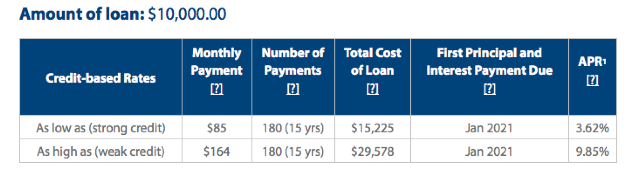
As you can see, the interest rate for the PNC loan ranges from 3.62% to 9.85%. This is a huge difference. The total cost of the loan with the highest rate is almost double that of the loan with the lowest rate. You won’t know the exact terms of the loan and interest rate until after you apply.
The interest rate will be determined based on the amount you’re borrowing, your or your cosigner’s credit history, and whether you choose a fixed or variable rate.
Our Top Picks For Best Student Loans
Best Federal Student Loans:
- Direct Subsidized Loan
- Direct Unsubsidized Loan
- Direct PLUS Loans for Parents & Graduates
Best Private Student Loans:
- College Ave – Best Overall
- Sallie Mae – Best for Graduate Students and Non-degree Granting Schools
- Credible – Best for Parents
- SoFi – Best for No Fees and Discounts
- Ascent – Best for Borrowers Without a Cosigner
- LendKey – Best Marketplace
Final Advice
If you want some specific ideas for the best private student loans, you can check out this list of the top 17 best-rated student loans by Consumer Affairs. Keep in mind that this list includes federal loans. If you read the reviews, you’ll realize that very few people seem to be happy with their student loans.
Try to minimize your private student loans. Private loans can be tempting because they’re easy to apply for, and you can often borrow as much as you want to pay for your educational expenses. However, remember that private loans should be a last resort. You don’t want to burden yourself with extremely high debt that you’re going to have to pay off for the next 20-30 years. I know people in their 40’s who are still paying off their loans.
Also, remember that you won’t be able to accurately compare loans until after you apply. Lenders will often advertise their most attractive terms, but you may come to find out that you’re only eligible for a much less favorable interest rate.
If you’re a US citizen or permanent resident and you need financial aid to attend college, make sure you fill out the FAFSA and submit it by the deadline. The FAFSA is used to determine your eligibility for federal aid, and many states and colleges use it to determine how much state aid or institution-based aid to give you.
Get good grades and high test scores. You can reduce the amount you’ll have to take out in private loans by getting merit scholarships. You don’t have much control over how much need-based aid you’re eligible for, but you can get more scholarship money by excelling academically. Many colleges and organizations offer merit scholarships for outstanding students.
Additionally, the most selective schools usually offer the best financial aid. If you’re able to get into one of these schools, you may get enough aid to cover your cost of education without having to take out private loans.
Apply for scholarships: the more, the better. So many students don’t apply for scholarships just because they don’t want to spend time writing essays or filling out applications. However, depending on your situation, you may be eligible for a number of great scholarships that will help you avoid taking out private loans. Because some scholarships are highly competitive, you’ll increase your chances of getting scholarship money by applying for more scholarships.

 collage