
Get more information Free Online Agribusiness Courses, best free entrepreneurship courses online, online college courses for agriculture, best online agriculture courses, best online courses on entrepreneurship, online agriculture courses in kenya & how to study agriculture online.
online college courses for agriculture
Agribusiness is at the core of most economies around the world. The business of feeding peopleremains both complex and extremely important. According to the World Bank, food and agribusiness is a US $5 trillion industry that represents 10 percent of global consumer spending.

In a global food system impacted by growing populations, economic growth, globalization, climate challenges, disruptive technologies, and evolving consumer demands, we must find smarter ways to produce food and to operate food businesses.
Guided bythe team at The Centre for Global Food and Resources, this course will introduce the concepts at the heart of agribusiness; including value chain thinking, the dynamics of markets, and the changing nature of consumer behavior.
You will learn what it is that sets agribusiness apart from other business sectors and the difference between supply chain and value chain thinking. You will gain an understanding of food markets and the distinctive factors that influence them. There will be a focus on the role that consumers play in the value chain – why they make the food choices they do and what changing food demand means for agribusiness. This course will showcase Australian agribusinesses, providing genuine insights into the concepts discussed.
In an increasingly complex sector, this course will help you think differently about the challenges and the opportunities that lie ahead for agribusiness.

Syllabus
Section 1:Global food systems and value chains In this section, you’ll learn how to recognise the characteristics of global food systems;identify the variables impacting global food systems;identify value chain thinking and how it differs from supply chain thinking;identify the role that external factors (for example, population and income growth, globalisation, climate change, technology and international trade) play on global food systems, agribusiness and value chains; andidentify the actors in, and characteristics of, value chains, demonstrated with the building of a value chain model.
Section 2: Agribusiness market dynamics In this section of the course, you’ll learn how torecognise the characteristics of agri-food markets, what influences their supply and demand, and what sets them apart from other markets;identify the role that external factors, such as population and income growth, globalisation, climate change, technology and international trade, play on agri-food markets;interpret the key elements of supply and demand; andrecognise the basic characteristics of supply and demand curves.
Section 3: The role of the consumer In this section of the course, you’ll learn how torecognise the role the consumer plays in the food system, markets and value chains;recognise the consumer characteristics, trends and behaviours that influence value chains; andrecognise some of the techniques used in market and consumer research to better understand consumer behaviour.
Section 4: Your next steps In this section you will gain additional insights into how you can apply your new skills and knowledge in the agribusiness sector, and what your possible next steps might be if you wish to further your study in this area.
Course end: December 31, 2018 at00:00 UTC.

Agriculture Courses
- Bugs 101: Insect-Human InteractionsUniversity of AlbertaCOURSERated 4.9 out of five stars. 981 reviews4.9(981)32K studentsBeginner
-
 Global Postharvest Loss Prevention: Fundamentals, Technologies, and ActorsUniversity of Illinois at Urbana-ChampaignCOURSERated 4.7 out of five stars. 126 reviews4.7(126)6.7K studentsBeginner
-
 Geographic Information Systems (GIS)University of California, DavisSPECIALIZATIONRated 4.8 out of five stars. 5285 reviews4.8(5,285)130K studentsBeginner
-
 Introduction to value based business analyticsHSE UniversitySPECIALIZATIONRated 4.4 out of five stars. 17 reviews4.4(17)2.4K studentsBeginner
-
 Feeding the WorldUniversity of PennsylvaniaCOURSERated 4.7 out of five stars. 162 reviews4.7(162)9.1K studentsBeginner
-
 Introduction to SustainabilityUniversity of Illinois at Urbana-ChampaignCOURSERated 4.7 out of five stars. 2148 reviews4.7(2,148)120K studentsMixed
-
 An Introduction to the U.S. Food System: Perspectives from Public HealthJohns Hopkins UniversityCOURSERated 4.7 out of five stars. 137 reviews4.7(137)12K studentsBeginner
-
 Agricultura urbana y periurbanaUniversidad Nacional Autónoma de MéxicoCOURSERated 4.7 out of five stars. 872 reviews4.7(872)43K studentsBeginner
-
 Design Thinking for the Greater Good: Innovation in the Social SectorUniversity of VirginiaCOURSERated 4.7 out of five stars. 352 reviews4.7(352)34K studentsBeginner
-
 Social EntrepreneurshipCopenhagen Business SchoolSPECIALIZATIONRated 4.6 out of five stars. 308 reviews4.6(308)26K studentsBeginner
- Discover Best Practice Farming for a Sustainable 2050University of Western AustraliaCOURSERated 4.6 out of five stars. 513 reviews4.6(513)27K studentsBeginner
- Sustainable Agricultural Land ManagementUniversity of FloridaCOURSERated 4.8 out of five stars. 294 reviews4.8(294)24K studentsBeginner
- Agriculture, Economics and NatureUniversity of Western AustraliaCOURSERated 4.7 out of five stars. 312 reviews4.7(312)32K studentsBeginner
- Challenges of Agribusiness ManagementUniversità BocconiCOURSERated 4.8 out of five stars. 120 reviews4.8(120)7.3K studentsMixed
- Sustainable Food Production Through Livestock Health ManagementUniversity of Illinois at Urbana-ChampaignCOURSERated 4.8 out of five stars. 425 reviews4.8(425)21K studentsBeginner
- Understanding Plants – Part II: Fundamentals of Plant BiologyTel Aviv UniversityCOURSERated 4.8 out of five stars. 952 reviews4.8(952)33K studentsIntermediate
- The Economics of Agro-Food Value ChainsTechnische Universität München (TUM)COURSERated 4.5 out of five stars. 296 reviews4.5(296)14K studentsIntermediate
- From Climate Science to ActionThe World Bank GroupCOURSERated 4.7 out of five stars. 259 reviews4.7(259)17K studentsBeginner
- Transformation of the Global Food SystemUniversity of CopenhagenCOURSERated 4.8 out of five stars. 584 reviews4.8(584)14K studentsBeginner
- Introduction to Food and Our EnvironmentStanford UniversityCOURSERated 4.8 out of five stars. 16 reviews4.8(16)Beginner
- Bugs 101: Insect-Human InteractionsUniversity of AlbertaCOURSERated 4.9 out of five stars. 981 reviews4.9(981)32K studentsBeginner
- Global Postharvest Loss Prevention: Fundamentals, Technologies, and ActorsUniversity of Illinois at Urbana-ChampaignCOURSERated 4.7 out of five stars. 126 reviews4.7(126)6.7K studentsBeginner
- Geographic Information Systems (GIS)University of California, DavisSPECIALIZATIONRated 4.8 out of five stars. 5285 reviews4.8(5,285)130K studentsBeginner
- Introduction to value based business analyticsHSE UniversitySPECIALIZATIONRated 4.4 out of five stars. 17 reviews4.4(17)2.4K studentsBeginner
- Feeding the WorldUniversity of PennsylvaniaCOURSERated 4.7 out of five stars. 162 reviews4.7(162)9.1K studentsBeginner
- Introduction to SustainabilityUniversity of Illinois at Urbana-ChampaignCOURSERated 4.7 out of five stars. 2148 reviews4.7(2,148)120K studentsMixed
- An Introduction to the U.S. Food System: Perspectives from Public HealthJohns Hopkins UniversityCOURSERated 4.7 out of five stars. 137 reviews4.7(137)12K studentsBeginner
- Agricultura urbana y periurbanaUniversidad Nacional Autónoma de MéxicoCOURSERated 4.7 out of five stars. 872 reviews4.7(872)43K studentsBeginner
- Design Thinking for the Greater Good: Innovation in the Social SectorUniversity of VirginiaCOURSERated 4.7 out of five stars. 352 reviews4.7(352)34K studentsBeginner
- Social EntrepreneurshipCopenhagen Business SchoolSPECIALIZATIONRated 4.6 out of five stars. 308 reviews4.6(308)26K studentsBeginner
how to study agriculture online
Agriculture is a scientific discipline that involves the study of various scientific, technical, and business subjects related to agriculture, horticulture, farm management, poultry, dairy, agricultural biotechnology, etc. recent times with cutting-edge research and continuous innovation in the industry.
Agriculture course details
Following are the highlights of agriculture courses:
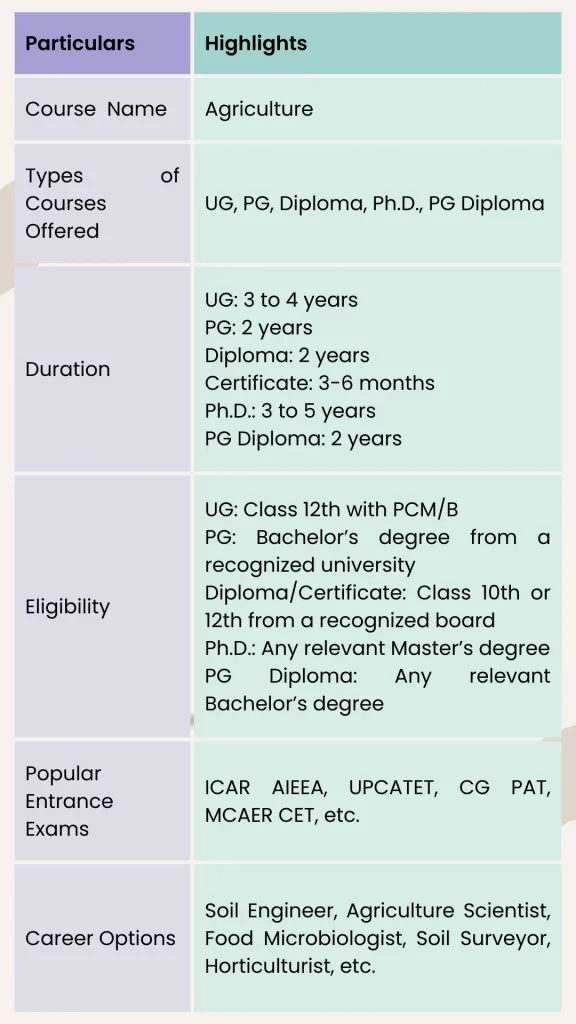
Agriculture courses list
In this section, we will discuss list of agriculture courses available.
Agriculture Certificate
Mainly offered by offline certification institutions and online institutions. Major areas: dairy and agriculture, agricultural science, food and beverage production, biofertilizer production, etc. Online certificate programs are extensive and mostly self-placed.
Popular certification agriculture courses are:
- Agriculture for Administrators by National Institute of Agriculture Management Extension (MANAGE)
- Agriculture, Economics, and Nature by Coursera
- Bio Organic Farming & Gardening by Udemy
- Bugs 101: Insects-Human Interaction by Coursera
- Certificate in Agriculture by Mohanlal Sukhadia University; Rajasthan Bharathidasan University, Tamil Nādu; Netaji Subhas Open University, Kolkata; Madurai Kamaraj University, Tamil Nādu
- Certificate in Food and Beverage Service by Bharati Vidyapeeth Deemed University, Pune; CT Institute of Hotel Management, Jalandhar; NIMS Kolkata
- Certificate in Food Production by IHM Bhubaneswar, IHMC Udaipur, IHM Guwahati
https://www.youtube.com/embed/CelHCIeh8zY?feature=oembedSource: Careers In Agriculture by Agriculture and Technology

Agriculture Diploma & PG Diploma
The best diploma and PG diploma courses in agriculture include food processing, seed technology, horticulture, organic farming, agro processing, harvesting technology. You can pursue these courses after 12th and in some cases after 10th too.
Top agriculture diploma & PG diploma courses are:
- Diploma in
- Agriculture
- Agriculture Engineering
- Hitech farming
- Horticulture
- Hybrid Seed Production Technology
- PGD in
- Agricultural Extension Management
- Management: Agribusiness and Plantation Management
- Technology Management in Agriculture
GET CAREER GUIDANCE AFTER 12TH
Under graduation courses
Full time agriculture degrees like BTech, BE, BSc Agriculture and BBA offered after completion of class 12th with Physics, Chemistry, Maths/Biology. The duration of these courses is 3-4 years. There are also integrated courses that increase the duration of the course. The integrated courses include B. Tech + M. Tech, BE + ME, B. Science + M. Science, and B. Sc + MBA.
Post graduate courses
Pursued by those who wish to study additional specialization course in a particular subfield. Disciplines include M. Tech, M. Sc and MBA. Job options are better if you pursue a master’s degree in agriculture.
Doctorate Agriculture Courses
Several universities offer PhD courses in various areas of agriculture for those who are seeking research and teaching opportunities. Several research scholarships are also available.
Top agriculture courses after 10th
| Courses/Diploma in | Duration | Fees |
| Agricultural Engineering | 3 years | Rs 35,000 yearly |
| Agriculture | 2 – 3 years | Rs 60,000 – Rs 70,000 yearly |
| Agriculture Science | 1 year | Rs 42,000 yearly |
| Horticulture | 1 – 2 years | Rs 20,000 – Rs 30,000 |
| Hybrid Seed Production Technology/ Seed Technology | 1 – 2 years | Rs 40,700 yearly |
| Organic Farming | 6 months – 2 years | Rs 5,000 – Rs 20,000 |
List of agriculture degree courses
Below are some of the agriculture degree courses you can take to pursue a career in agriculture:
- BSc in
- Agriculture
- Agriculture and Food Business
- Forestry
- Animal Husbandry
- Agriculture Economics and Farm Management
- Fisheries
- Crop Physiology
- MSc in
- Agricultural Production
- Agronomy
- Agriculture
- Integrated Plant and Animal Breeding
- BBA in Agricultural Management
- MBA in Agriculture

Leave a Reply